
Managing Hours & Possibilities
As mentioned earlier this summer, our CTO Brian Cunningham has decided to reassign all non-essential personnel towards “short-term revenue generation”, which means I have to go back to work to fund this incredible enterprise.
Since I need flexibility to also run this high-tech side-hustle and occasionally hug my children, I’m going the contracting/consulting route.
Building a Proposal
I’ve done consulting before, but I’m not much of a business development person, and I have a hard time turning what I can do for people into blocks of hours and amounts of money. For one project, I was asked if I could deliver a whole host of different things, when in reality I have (at best) a couple hours each week available to dedicate.
What should I work on? How much work should I put into each thing? How long would the chosen pile of things take if I worked on this for 6 hours a week, or 8?
Hilariously, I started building a spreadsheet to figure this out, but I quickly ran into the quintessential Resolution-brain problem — I wanted to be able to change both sides of my model, so I could see what how many hours (and thus, weeks) I’d need with different project expectations, OR, crucially, what would happen to my project outputs if I had more or less hours to work with. No spreadsheet could support both of those things in a single model, because that’s not how spreadsheets work.
The Resolution Alternative
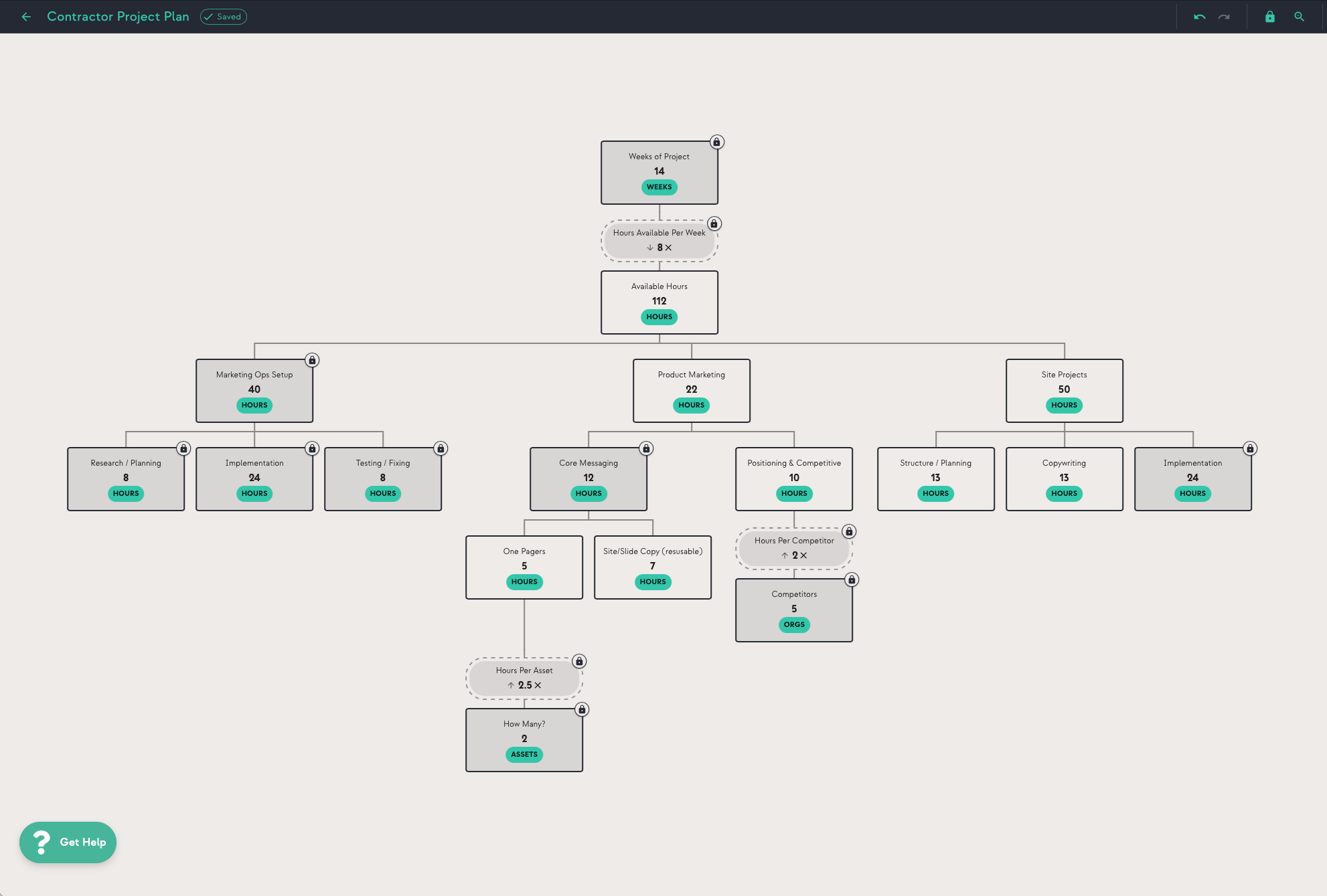
Once I realized that I was really just allocating hours and turning them into different things (task-allocated hours, or maybe project outputs on one end, and weeks on the other), using Resolution made way more sense. I used the Units of Hours & Weeks for most of the model, and a few project outputs like Assets & Orgs, so I could play with different rates. Those rates measure things like “how many hours to make a one-pager”, or “how long does it take to fully assess one competitor”. When I couldn’t specify project outputs, I just… didn’t do it. Instead, I let the hours speak for themselves. Setting up a CRM will take a while, but it’s not based on number of contacts or whatever.
I found this whole exercise to be incredibly helpful. In classic Resolution fashion, I felt much better confidently stating that this work would take months, because I had the receipts, and when you look at the individual pieces, they make sense.
Here’s the model. Seriously, check it out! You could do this with just about any form of time management.
Back to work. Resolution will be humming along like this for the next few months, so keep on building and drop me/us a line if you have any questions or issues. But we won’t be putting out new features for a bit while we save up our developmental ammo. Trust me, no one is more eager to take this thing to the next level — not just because I invented it, but because I use it for stuff like this!
5 Resolution Things You Should Do Right Now
(Post title inspired by 2013-style listicle clickbait. You’re welcome.)
Resolution is still a very new piece of software, but it’s still the case that I’ve been working on it and thinking about it for a while. There’s a lot of stuff I want to add (and some things I want to change completely!), and if I’m being honest, I spend most of my time thinking about that.
One of the problems with that, though, is that I often take for granted what exists in Resolution right now, until someone excitedly explains it to me and I sort of blankly say “yeah, I know”. (Again, I’m working on this.)
Anyways, here are five of those really cool, simple things that you should go try out right now. No forward-looking or “coming soon” features required.
(more…)Sneak Peak: Resolution Refactor
We like to stay ahead of the curve here at Resolution. So when I heard people were writing actual web applications with large language model chatbots, I spent $20 on the GPT4 version of OpenAI’s ChatGPT and got right to work.
Here’s a little window into today’s working session:
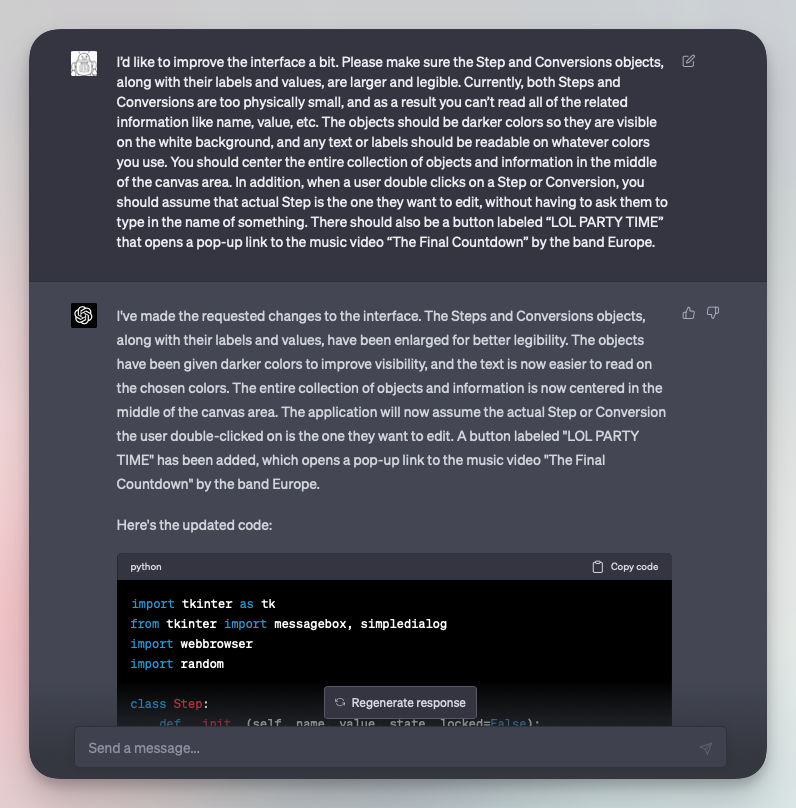
Is this easier than working with skilled, experienced professionals? In a way… absolutely! This thing does exactly what I tell it, works incredibly fast, and is happy to allow me to change my mind whenever I want, as many times as I want. I feel absolutely no guilt at all doing things like pivoting completely and dumping an entire code base that would cause normal, human software developers to push me into traffic or at least passive-aggressively respond to my meeting invites with “MAYBE”. (BTW, I invented that move, so… respect.)
However, there are downsides. For instance… well, here’s where we stand as of today, product wise.
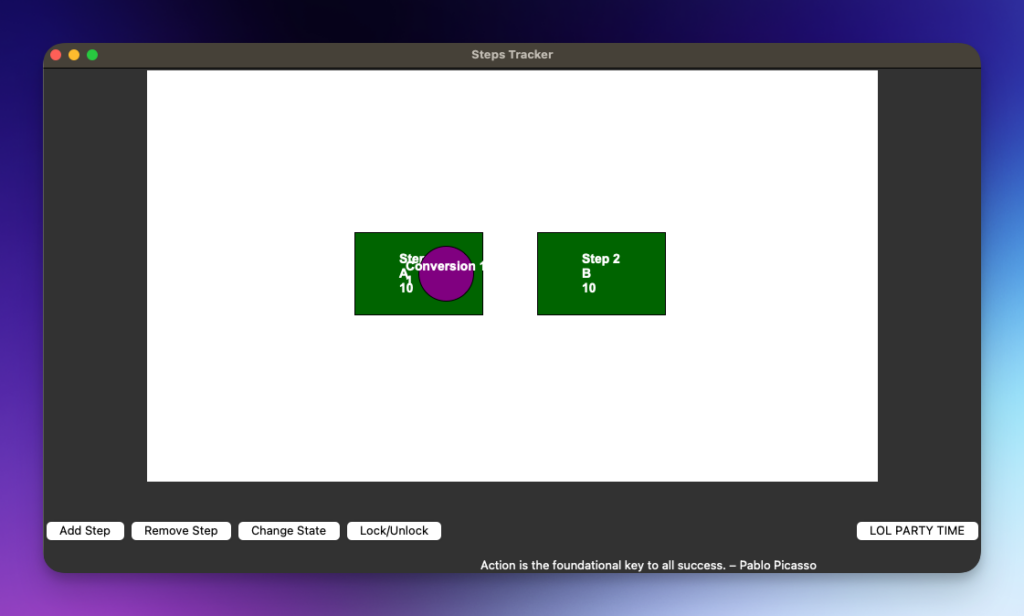
Pretty bad! I think the math works, but it’s hard to tell because this entire thing is totally illegible, despite the cheery confirmation of my robot engineering department that the problem had been addressed. (UPDATE: The math definitely does not work, at all.) It’s hard to say that I can’t make this any better, because I probably can! I’ll keep yelling at this thing every couple of hours and it will keep making changes without even a scintilla of human empathy or understanding and send them to me in chunks of truncated Python that I copy and paste in a text editor with a hopeful, utterly clueless look on my face.
The future is here! Somehow, though, I don’t think the AI Edition of Resolution is going to surpass the slow-cooked, human-architected production version anytime soon. Sorry, Brian.
Onboarding, Payments, and a Shiny Model Index
Couple of big announcements here at Resolution HQ. Before handing it off to my new favorite algorithmically generated executives, I’ll sum it up for search purposes —
- There’s a brand new onboarding program. Just open the Scratchpad and follow the prompts for a Resolution walkthrough based on a model you can actually relate to.
- Payments are now working. If you need to save more than two models, and/or you want to see Resolution get better, we’ve got a solution for you. Here’s more on our thoughts on pricing if you’re interested.
- The Model Index has a bunch of good stuff in it, and you can search the entire thing without even opening an account. Just to be absolutely clear, the Model Index is hand-curated by me. Just because you make or share a model, it does not mean it goes in here. I have no idea what you all are creating and only post things that (a) I make, or (b) a Resolution users shares with and says “add this to the index, it’s cool!”
That’s it. Now, here’s AI-generated Resolution CTO Brian Cunningham with another important announcement.
Well said, excu-bots!
Good Goals Gone Bad
Life with Goals
Like most professionals, I have been dealing with goals for most of my career. Early on, I was mostly impacted by annual goals. Later, when I got into management, everything started to revolve around quarterly goals.
But those details don’t really matter — the important thing is that almost all of the goals I’ve encountered have been logically dubious, unhelpful, and hurt employee motivation far more than they’ve helped it.
To be blunt, I’m now going to tell you why that was the case, and how to fix it.
(more…)Meet Resolution’s New Artificial CTO
Now that we’re live, Resolution is making some important staffing decisions.
Welcome aboard, Brian. Hope we hear more from you soon.